

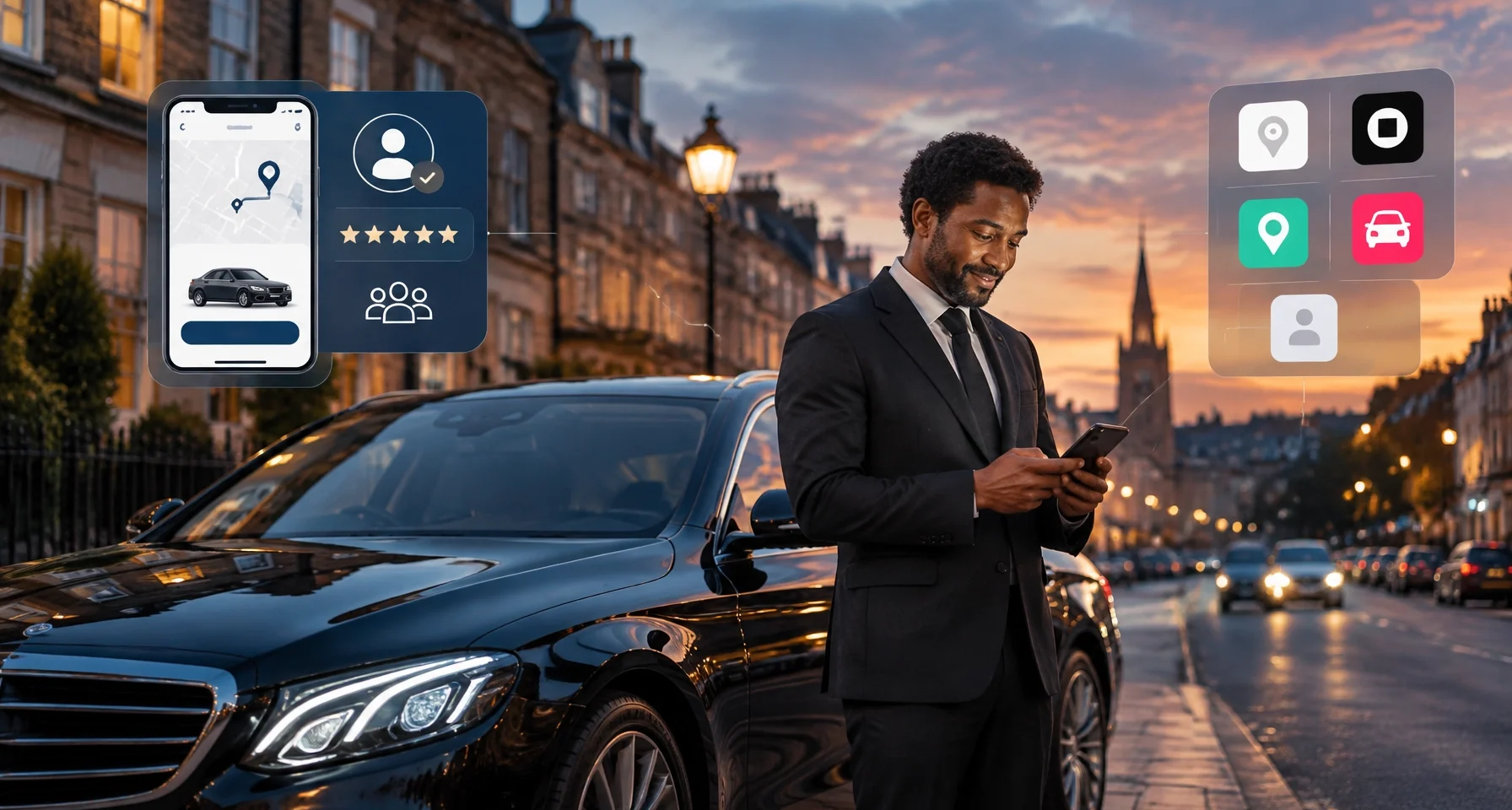
Taxi Booking Sites vs Ride-Hailing Apps: Which Is Better for Your Private Hire Firm?
For a UK private hire firm, a ride-hailing app can bring in bookings without a big marketing effort. Your own website or booking app can help you build repeat business and keep more control over each customer relationship.
They solve different problems. One gives you access to demand; the other gives you an asset you own. The right choice depends on your fleet, customer mix, operating capacity and appetite for marketing. For many firms, the strongest answer is to use both deliberately.
RUN YOUR OWN BOOKING CHANNEL: MORE CONTROL, MORE RESPONSIBILITY
Your own channel might be a mobile-friendly website, a branded app, or both, connected to booking and dispatch software. Customers book directly with your firm, and you manage the service from enquiry to drop-off.
What you gain:
- No platform commission per job. You avoid paying a third party a percentage of each direct booking, although payment processing and software costs may still apply.
- A customer relationship you can build. With appropriate consent and data practices, you can use booking history to make repeat bookings easier and communicate relevant offers or service updates.
- Control over your brand, pricing and service. Customers book your firm, not an invisible vehicle on someone else’s platform.
- A route to regular and account work. Corporate travel, school contracts, hotel partnerships and airport transfers often depend on reliability and a direct relationship, not just a one-off app booking.
But owning the channel does not mean bookings arrive automatically. You pay to build, run and maintain it. You also take responsibility for generating demand, handling customer queries and keeping the booking process working. A website that is hard to use or a phone line that goes unanswered can lose the booking just as quickly as a poor platform experience.

USE A RIDE-HAILING APP: QUICKER ACCESS TO DEMAND
A ride-hailing platform can help get your vehicles working, particularly when you are starting out, expanding in a new area or trying to fill quieter periods. It offers access to customers already using the app, with relatively little upfront marketing from your firm.
That convenience has a trade-off. Platforms typically charge for access to bookings, and the amount and terms depend on the service and agreement. Check the current terms carefully rather than relying on another operator’s experience or an old online comparison.
You may also have less say over fares, which jobs you see and how visible your firm is. The customer’s relationship is mainly with the platform. Changes to its commission, ranking or booking rules can affect your work without giving your business much control over the decision.
In practice, the key question is not simply “What commission do they charge?” It is “What would this job be worth to my business if I won it directly?”
THE ECONOMICS: COMMISSION VS CUSTOMER VALUE
Commission is easy to see on a statement. The value of a customer is spread across repeat journeys, referrals and account work.
For illustration only, imagine a platform took 20% on a £20 fare. That would mean £4 goes to the platform. Across 100 similar jobs, that adds up to £400. The example is not a claim about any particular app’s rates; actual fees and fares vary.
A direct booking is not free to win. You may have paid for software, advertising, website work or staff time, and you still need to cover vehicle, driver, insurance and operating costs. The fair comparison is therefore:
Platform commission on a job versus the cost of attracting and serving a direct customer, including the likely value of future bookings.
A one-off job during a quiet shift may be worth taking through a platform, even after the fee, if the alternative is an idle vehicle. A repeat airport customer or a business account could be more valuable through your own channel, where you can build the relationship and manage service directly.
Track both routes. Compare net income after fees and acquisition costs, time spent handling each booking, repeat rates and how often vehicles would otherwise be idle. That gives you a view of contribution to the business, rather than a headline percentage in isolation.
WHY MANY FIRMS CHOOSE BOTH
This does not have to be an either-or decision. A hybrid approach can use platforms as a demand tap you rent and your own booking channel as the long-term asset you build.
Use platforms selectively to introduce your service to new customers, provide work for available drivers or cover quieter periods. Grow your own channel for repeat passengers, corporate accounts, school runs and pre-booked airport transfers, where dependable service and a direct point of contact matter.
Set clear operating rules. Know which jobs make sense after fees, avoid relying on one source for all bookings, and check that any customer communication and data use follow applicable requirements. Your firm remains responsible for its private hire licensing obligations, including using appropriately licensed drivers and vehicles.
WHAT YOUR OWN BOOKING CHANNEL NEEDS IN 2026
A logo and a booking form are not enough. Customers expect a straightforward service on their phone, and dispatch needs to work reliably behind the scenes. At a minimum, a competitive channel should provide:
- Mobile-first booking with clear fares or quote information before a customer commits.
- Instant confirmation and an accurate pickup ETA, with updates when plans change.
- Card and cash options, where suitable for your operation.
- Account and corporate booking with a practical way to manage repeat journeys.
- Airport-transfer pre-booking, including collection details and clear instructions for passengers.
- Driver dispatch that gives your team a useful view of jobs, vehicles and booking status.
- Clear communication, so customers know what happens next and how to get help.

Think about busy periods too. AI phone agents or chatbots can help capture routine booking details or answer basic questions when call volumes peak, with a clear route to a person when a booking is complex or something goes wrong. Automation should reduce missed enquiries, not make it harder for passengers to reach your team.
For more on operational support, see our guide to**** smarter 24/7 customer support and manual dispatch.
DEMAND IS WHAT MAKES OR BREAKS DIRECT BOOKINGS
An owned channel only pays off if customers can find it and complete a booking. For local operators, that means being visible for searches such as “taxi [town]” and “airport transfer [town]”, keeping your Google Business Profile accurate, and earning reviews that reflect the service you deliver.
Then remove friction at the last step. Make pickup details, price or quote expectations, payment options and confirmation clear. A slow, confusing booking flow can waste the marketing effort that brought the customer to your site in the first place.
This is where Local SEO Services UK and a consistent local search presence can support demand generation. Our guides on**** winning the local pack and common website lead-generation problems cover practical steps. For broader planning, explore SEO Services UK, SEO Services for Small Business and what a**** Digital Marketing Agency UK can contribute.

A PRACTICAL DECISION CHECKLIST
Before investing in an owned channel, or increasing platform reliance, work through these questions:
- How many jobs do you handle on a typical day? Consider busy and quiet periods, not just your best week.
- What share comes from repeat customers versus new customers? A strong repeat base may justify making direct rebooking easier.
- Do you have account or contract work? Corporate journeys, school runs and hotel work may benefit from direct service and account management.
- How important are airport transfers? Pre-booked work can suit a channel that captures journey details and sends timely updates.
- Can you generate demand? Be realistic about time and budget for local search, reviews, partnerships and advertising.
- Have you budgeted for the whole channel? Include setup, software, payment costs, maintenance, marketing and customer support.
- Are you ready to own support? Decide who will handle booking changes, missed pickups, complaints and out-of-hours questions.
If several answers point to a strong repeat or account customer base, invest in a direct channel in manageable stages. If you have spare capacity and limited marketing resources, platforms may help keep work moving while you build visibility. If both are true, a measured hybrid is likely the more resilient route.
THE VERDICT: BUILD AN ASSET, RENT EXTRA REACH
Your own booking channel offers control, customer relationships and the chance to avoid per-job platform commission, but it brings the work of marketing, maintenance and support. Ride-hailing apps offer access to existing demand with less upfront effort, but you pay for that access and accept less control.
The strongest private hire firms treat the choice as an operating decision, not a loyalty test. Build direct bookings where repeat value and service control justify the effort. Use platforms when the work makes commercial sense, particularly to fill capacity.
Global Marketing Firm works with taxi and transportation businesses on booking, dispatch, customer support and digital growth. Our work is backed by a 100% on-time delivery record and an 85% repeat business rate, with a focus on scalable, sustainable solutions. The right channel mix starts with your operation: listen to your needs, understand the numbers, and build around the customers you want to keep.