

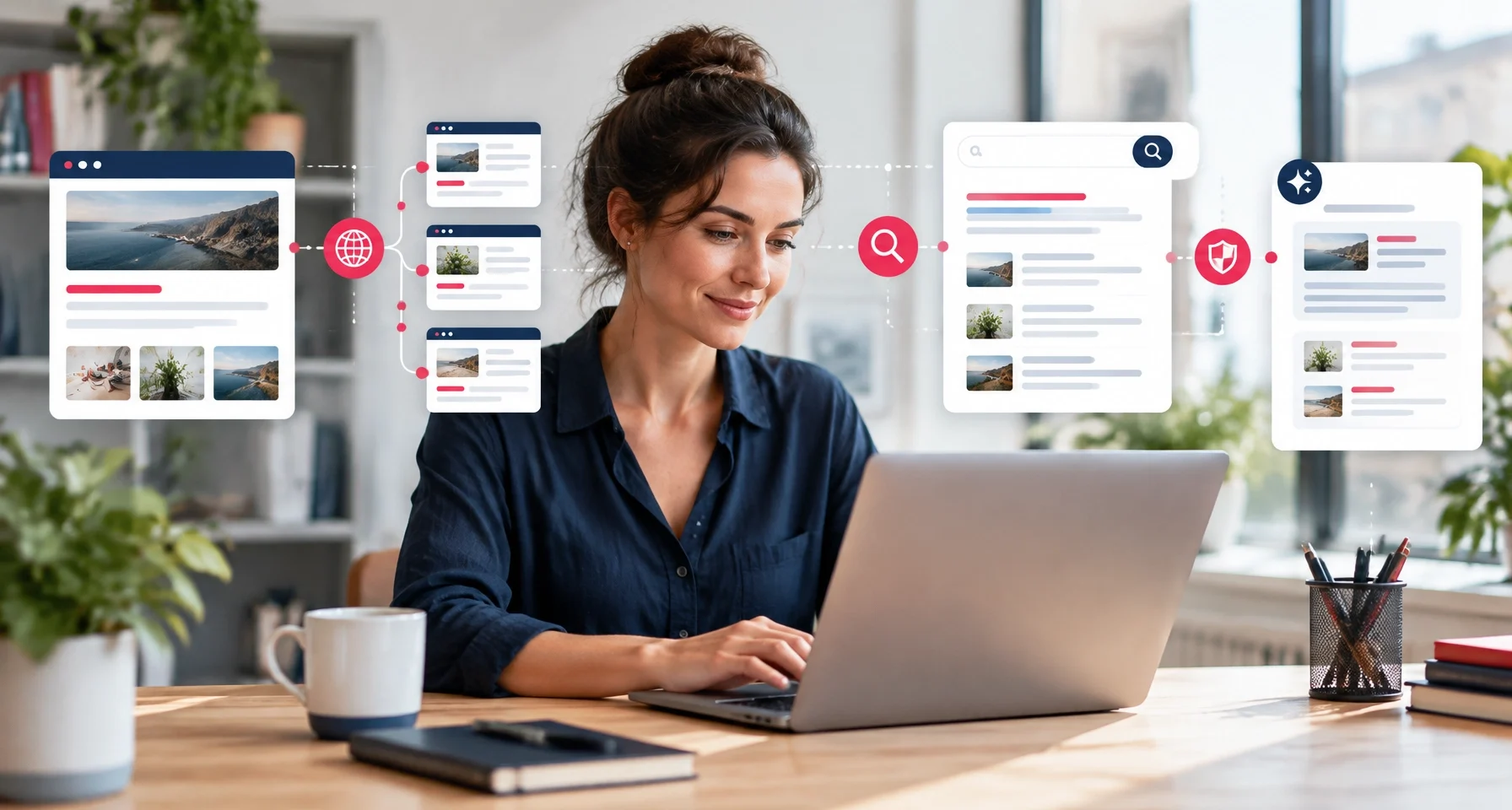
How to Optimise Your Website for ChatGPT and Google AI Search
Customers increasingly ask ChatGPT, Gemini or Google a question before they visit a website. For a small business, that creates a new challenge: your services may be exactly what someone needs, but your business may not appear in the AI-generated answer.
The good news is that getting ready for AI search is not a separate dark art. Google and OpenAI both point back to familiar fundamentals: make your website accessible, useful and easy to understand. Here is a practical plan you can start this month.
HOW AI SEARCH FINDS AND USES YOUR WEBSITE
AI search systems may retrieve information from web pages to help answer a question. First, they need to be able to access your site. Then, they need to understand what a page says and whether it is useful for the question being asked.
That means visibility depends on three basics: your content must be retrievable, readable and clear enough to quote accurately. A plumber whose site clearly lists the areas served, emergency hours and services has given an AI system more useful information than a site that only says “quality plumbing solutions".
Different crawlers have different purposes. Googlebot crawls pages for Google Search. OpenAI’s OAI-SearchBot supports ChatGPT search, while GPTBot relates to potential model training. ClaudeBot and PerplexityBot are used by other AI services. Review your robots.txt rules carefully: blocking a crawler can limit access to your content on that service. Allowing search access and making a separate decision about training access are not necessarily the same choice.
FIX THE TECHNICAL FOUNDATIONS FIRST.
Before rewriting content, check that search systems can reach and read your important pages.
- Check robots.txt and indexing. Make sure you have not blocked Googlebot or other crawlers that want to reach your site. Look for accidental
noindexsettings on key pages. - Keep important content in accessible HTML. If your services, prices or FAQs only appear after a script runs or a button is clicked, some systems may not process them reliably. Keep essential information visible in the page itself.
- Make mobile pages fast and usable. Test your site on a phone, compress large images and remove unnecessary scripts. Core Web Vitals are a useful way to assess loading, responsiveness and visual stability.
- Use HTTPS and accessible markup. Secure pages, descriptive headings, clear link text and image alt text help people and machines understand your site.

If a page is slow, difficult to navigate or unavailable to crawlers, improving its wording alone will not solve the problem. Our guide to common website lead-generation mistakes covers several related issues.
WRITE ANSWERS PEOPLE AND AI CAN USE.
Organise pages around the questions customers actually ask. A useful service page should state what you do, who you help, where you operate and how to get started.
Try this structure:
- Start with a direct answer. Under a heading such as “Do you provide emergency plumbing in Leeds?”, answer the question in one or two clear sentences.
- Add specific detail. State the areas covered, opening hours, what is included and any relevant conditions. Do not promise a response time or service you cannot reliably deliver.
- Break up the information. Use clear H2 and H3 headings, short paragraphs, numbered steps and comparison tables where they genuinely help.
- Answer common questions. Add useful FAQs about booking, delivery, service areas, pricing or next steps.
- Show when information was updated. A visible review or update date helps readers judge whether details such as availability or service coverage are current.
Vague phrases like “we are the best in class” do not tell a customer, or an AI system, what you actually provide. Concrete, accurate information does.
MAKE YOUR BUSINESS EASY TO IDENTIFY AND TRUST.
AI systems need to distinguish your business from others with similar names. Keep your business name, address and phone number consistent across your website and business listings. If you serve customers at their location rather than from a public shop, describe your service area clearly instead of publishing an address that could mislead visitors.
Create an About page that introduces the real people behind the business and explains their experience. Give each service a clear page. A salon in Bristol, a BnB in York and a taxi firm serving several London boroughs should all name their relevant locations naturally.
Reviews also help customers assess credibility. Ask for honest feedback after a completed job, and respond professionally to both praise and concerns. Our guide to building review momentum explains why consistent, genuine reviews matter.

USE STRUCTURED DATA FOR CLARITY, NOT MAGIC.
Structured data, often called schema, is a way to label information on a page so search systems can interpret it more easily. For a small business, relevant types may include LocalBusiness, Organisation, Service and, where appropriate, Product.
Schema is not a shortcut to AI citations or higher rankings. It should describe information that is also visible on the page. Common mistakes include adding incorrect opening hours, using the wrong business type or leaving outdated details in the markup. If you change your address or services, update the structured data too.
CREATE A SIMPLE AI DISCOVERY FILE WITH REALISTIC EXPECTATIONS.
Some businesses publish a llms.txt file as a short guide to their website. It can summarise who the business is, what it offers, where it operates and which pages are most useful.
Keep it brief and accurate, and treat it as an optional signpost, not a ranking tool. Google does not require a special AI text file for AI Overviews or AI Mode, and a file cannot replace a crawlable website, clear service pages or good internal links. Our AI Discovery File guide explains how to approach it without overpromising.
SHOW FIRST-HAND EXPERIENCE
Useful content reflects work you have actually done. Add original photos, explain your process and include real examples when you have permission to share them. A taxi firm might describe how bookings are handled across its service area; a BnB could explain parking, check-in and nearby transport in practical detail.
Do not invent testimonials, results or customer stories. Specific, verifiable information is more helpful than broad claims. For more on how search systems are changing, read AI Mode Is Full of Links Again and Gemini 4 Argon.
BRING SEO, PAID SEARCH AND CUSTOMER SUPPORT TOGETHER
AI visibility builds on good SEO services: technical health, helpful content and local business information. It does not replace a wider digital marketing plan. For example, Google Ads can support paid visibility and capture demand when customers are ready to act, while your website gives them the information they need to choose you.
A joined-up approach connects your site with search engine optimisation, paid search and customer support. Explore our digital marketing solutions for an overview of how these channels can work together. If customers arrive with questions, AI chatbot solutions for small businesses can provide quick answers and direct more complex enquiries to a person. The assistant should be clear about what it can answer and offer a human handover.
For businesses serving international customers, digital marketing trends in Pakistan also highlight the importance of mobile-first pages and convenient, chat-based contact. The same fundamentals apply, but the language, preferred channels and customer expectations may differ by market.
YOUR 30-DAY ACTION CHECKLIST
Week one: access and performance
- Review robots.txt and check that important pages are indexable.
- Test mobile usability, loading speed and HTTPS.
- Check that key page content is available without relying on scripts.
Week two: clearer answers
- Rewrite your most important service and location pages with direct opening answers.
- Add useful FAQs based on real customer enquiries.
- Make service areas, inclusions and next steps explicit.
Week three: trust and structure
- Check your business details across your website and listings.
- Add or validate relevant structured data.
- Request honest reviews from recent customers and respond to them.
Week four: measure and refine
- Test a fixed set of customer questions in ChatGPT, Gemini and Google AI Mode.
- Record whether your business is named, cited or linked.
- Review branded searches, direct visits and the quality of incoming enquiries.
MEASURE AI VISIBILITY HONESTLY
AI answers can change, and a mention is not the same as a citation or a customer enquiry. Test the same questions periodically and keep separate notes on whether your business is mentioned, whether your website is linked and whether that visibility produces relevant leads.
Watch website enquiries, branded searches and referral traffic alongside the results of your tests. Be cautious of anyone promising guaranteed AI rankings. No agency can control which answer a platform gives to every user.
MAKE YOUR WEBSITE CLEAR, USEFUL AND TRUSTWORTHY
Optimising for AI search means making it easier for people and systems to understand what you do and why your business is credible. Start with access, accuracy and useful answers; improve the details over time.
Global Marketing Firm brings technology and marketing together, with a 100% on-time delivery record, an 85% repeat business rate and specialist experience in taxi and transportation solutions. We focus on sustainable, scalable work that supports real business needs. Talk to our team about improving your website and the customer journey around it.