


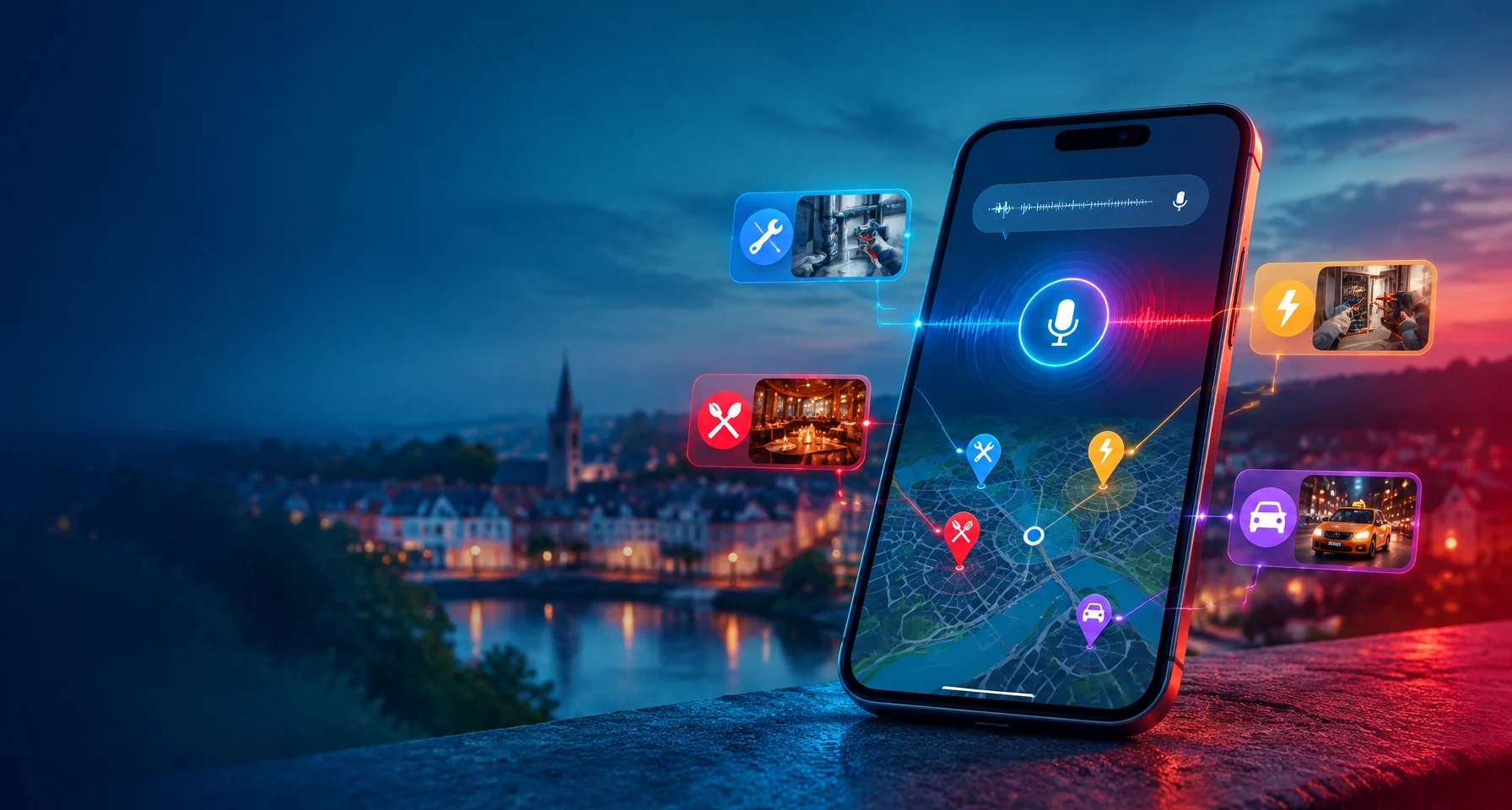
“Hey Google, Which Plumber’s Open?” , How Voice Search Is Reshaping Local SEO for UK Small Businesses
“Hey Google, which plumber’s open?”
A few years ago, voice search felt like a novelty. Today, it is becoming a direct route from urgent customer need to local business enquiry.
With Google’s Gemini 3.8 Live launch bringing real-time voice conversations into Search in 2026, people can ask more natural questions, refine their requests and receive immediate recommendations. They are no longer typing short phrases such as “plumber London” or “electrician near me”. They are speaking complete requests:
- “Which plumber is open near me right now?”
- “Find a highly rated electrician who covers Leeds.”
- “What is the best Indian restaurant open after 10 pm?”
- “Can I book a taxi from Manchester Airport in 20 minutes?”
For UK small businesses, this creates a clear opportunity. Businesses with accurate local information, strong reviews, useful content and responsive customer support can become the answer customers hear first.
Businesses with outdated listings, unclear availability and unanswered enquiries risk being ignored.
WHAT CHANGED: SEARCH BECAME A CONVERSATION
Traditional search relies heavily on short keywords. Voice search is different. It is conversational, question-based and connected to immediate intent.
A customer may type “emergency plumber Birmingham” into Google. However, when speaking to an assistant, they are more likely to say:
“I’ve got water coming through the ceiling. Which emergency plumber is open in Birmingham now?”
That longer question contains several important signals:
- Service: emergency plumbing.
- Location: Birmingham.
- Urgency: now.
- Problem: water coming through the ceiling.
- Decision criteria: availability and proximity.
Gemini can use these signals to interpret the request and present businesses that appear relevant, nearby, open and trustworthy.
This means local SEO is no longer limited to ranking for one or two target phrases. Your business must be understandable across a broad range of natural-language searches.
Our guide to Local SEO in 2026 explains how the Local Pack and AI search features work together. Voice adds another layer: your business information must be clear enough for an AI system to understand and concise enough to become a useful spoken answer.
WHY LOCAL BUSINESSES WIN OR LOSE
Voice search often produces fewer visible options than a traditional results page. Customers may hear one recommendation, a short list or a direct answer based on location, availability, reviews and relevance.
That makes your local business data decisive.
GOOGLE BUSINESS PROFILE ACCURACY
Your Google Business Profile is one of the most important sources of local business information. Keep every core field accurate:
- Business name.
- Address or service area.
- Telephone number.
- Opening hours.
- Holiday and special hours.
- Primary and secondary categories.
- Services.
- Booking or enquiry links.
- Business description.
- Frequently asked questions.
- Photos.
If your profile says you are open until 8 pm but your phone goes to voicemail at 7 pm, the customer experience breaks immediately. If your category says “plumber” but your website focuses mainly on heating installations, Google may struggle to match your business to the right question.
Do not claim to offer 24/7 service unless you can deliver it. Accurate information builds stronger trust than exaggerated availability.
REVIEW VELOCITY AND QUALITY
Reviews do more than display a star rating. They show that customers continue to use your business and describe the experience in their own words.
A steady flow of recent, genuine reviews can support searches involving:
- Reliability.
- Speed.
- Professionalism.
- Emergency response.
- Local service areas.
- Quality of completed work.
A plumber whose recent reviews mention “Sunday call-out”, “arrived within the hour” and “fixed the burst pipe quickly” has stronger relevance for urgent, availability-led searches than a business with only generic historic feedback.
Ask customers for honest reviews after completing work. Respond professionally to positive and negative feedback. Never manufacture reviews or pressure customers to use specific wording.
QUESTIONS, PHOTOS AND LOCAL CONTEXT
Google Business Profile questions and answers can help address the concerns customers raise before making contact.
Useful questions include:
- Do you offer evening call-outs?
- Which postcodes do you cover?
- Are you available on bank holidays?
- Do you provide free quotations?
- Can you handle commercial properties?
- How quickly can you usually respond?
Photos also matter. Upload real images of your team, vehicles, premises, completed projects and service areas. A restaurant should show its dining environment and dishes. A taxi company should show its fleet. A plumber should show professional equipment and completed work.
These assets make your business more credible to customers and easier for search systems to understand.

THE AFTER-HOURS OPPORTUNITY
Voice searches are especially valuable outside standard office hours.
A customer with a broken boiler may search at 11:30 pm. A traveller may need a taxi at 4:45 am. Someone locked out of their property may not wait until the next working day.
This creates a critical question:
What happens after a customer finds your business?
If the call reaches voicemail, the website lacks a clear next step or nobody responds to an online enquiry, your visibility does not convert into revenue.
Local SEO and customer support must work together.
Businesses offering genuine out-of-hours support should make that availability clear across their Google Business Profile, website, local landing pages and customer communications. Use accurate language such as “24-hour emergency plumbing”, “evening taxi dispatch” or “weekend support” only when the operation can support the promise.
Global Marketing Firm provides 24/7 customer support and communication solutions designed to help businesses manage calls, enquiries and dispatch activity beyond standard working hours. This is particularly important for taxi and transport operators, where a missed booking can immediately become lost revenue.
Voice search creates the opportunity. Responsive support closes the gap.
BUILD CONTENT FOR NATURAL-LANGUAGE QUESTIONS
Your website should answer the questions customers actually ask.
Do not create pages filled with awkward keyword repetitions such as “plumber Birmingham plumber Birmingham plumber Birmingham”. Create clear service and location pages that explain what you do, where you operate and what customers can expect.
A strong local landing page should include:
- The service and location in the page title.
- A direct summary near the beginning.
- Areas or postcodes covered.
- Opening hours and response times.
- Common customer problems.
- Pricing or quotation guidance where appropriate.
- Genuine reviews or project examples.
- Frequently asked questions.
- A prominent click-to-call or booking option.
Use answer-first writing. Put the essential information near the top of the page.
For example:
“Yes. We provide 24-hour emergency plumbing call-outs across Leeds, including burst pipes, boiler leaks and overflowing toilets. Call our response team for current availability.”
This structure helps customers, voice assistants and AI-generated search results understand the answer quickly.
Our guide on AI Overviews and Gemini citations explains why answer-led content is increasingly important. Your goal is not simply to rank. Your goal is to become a clear, credible source that search systems can use.
THE VOICE-READY LOCAL SEO CHECKLIST
Use this checklist to prepare your business for conversational search in 2026.
1. STANDARDISE YOUR NAP
Check your business name, address and phone number across:
- Google Business Profile.
- Website.
- Social profiles.
- UK business directories.
- Trade directories.
- Local landing pages.
Small inconsistencies can create uncertainty. Use the same spelling, formatting and contact details everywhere.
2. REVIEW YOUR OPENING HOURS
Confirm that your regular, seasonal and bank holiday hours are correct. If your service area operates differently from your office, explain the distinction clearly.
Do not advertise “open now” availability if customers cannot reach a real person or receive a prompt response.
3. ADD LOCAL BUSINESS SCHEMA
Use relevant structured data, such as LocalBusiness, Service and FAQPage where appropriate. Include accurate details such as:
- Business name.
- Address.
- Phone number.
- Opening hours.
- Service areas.
- Main services.
Schema does not guarantee a voice result. It helps search engines interpret information that is already visible and accurate on your website.
4. CREATE FAQ CONTENT
Write questions in the language your customers use:
- “Are you open on Sundays?”
- “Which areas do you cover?”
- “How quickly can you arrive?”
- “Can I book a taxi for early morning?”
- “Do you offer emergency call-outs?”
- “What should I do before an electrician arrives?”
Keep answers direct, useful and honest.
5. TRACK VOICE-DRIVEN ENQUIRIES
Voice searches are not always reported as a separate channel. Track the actions that indicate local intent:
- Calls from Google Business Profile.
- Click-to-call website interactions.
- Booking form submissions.
- Direction requests.
- Enquiries mentioning “found you on Google”.
- Calls received outside standard hours.
- Conversion rates by location and service.
Use call tracking carefully while keeping your primary business number consistent across important listings.

MAKE YOUR BUSINESS DISCOVERABLE TO AI
Voice search is part of a wider change in how customers discover businesses. Google, Gemini and other AI systems increasingly combine information from your website, business profile, reviews and local references.
Your business should present one consistent identity across every channel.
The AI Discovery File provides a useful framework for organising your key services, locations, expertise and supporting content so that AI systems can interpret your business more effectively.
The foundation remains straightforward:
- Publish accurate information.
- Keep important pages current.
- Demonstrate real experience.
- Answer customer questions.
- Support claims with evidence.
- Make contact simple.
- Deliver the service you advertise.
PARTNER WITH A DIGITAL MARKETING AGENCY UK BUSINESSES CAN RELY ON
Voice search rewards businesses that combine local visibility with operational readiness.
Global Marketing Firm delivers integrated SEO, content, Google Business Profile optimisation, PPC, web development and customer communication solutions. Our SEO services for small business are designed to improve visibility, attract qualified enquiries and turn local searches into measurable business growth.
As a results-focused digital marketing agency UK businesses can work with, we bring a structured process to every engagement: listen, understand, plan, deliver and measure.
Our performance record includes:
- 100% on-time delivery.
- 85% repeat business rate.
- Scalable technology and marketing solutions.
- Specialised expertise in taxi and transportation operations.
- Sustainable and ethically driven delivery.
CONCLUSION: BE THE ANSWER CUSTOMERS HEAR FIRST
“Hey Google, which plumber’s open?” is not just a voice command. It represents a new customer journey built around urgency, proximity, trust and availability.
UK small businesses that maintain accurate profiles, generate genuine reviews, publish answer-first content and provide responsive support will be better positioned to win this journey.
Optimise your local presence. Make your availability clear. Track every enquiry. Then ensure someone is ready to respond when the customer calls.
That is how voice search becomes more than visibility. It becomes a reliable source of growth.