


Digital Marketing, SEO, and Social Media Marketing: The Complete Guide for UK Small Businesses
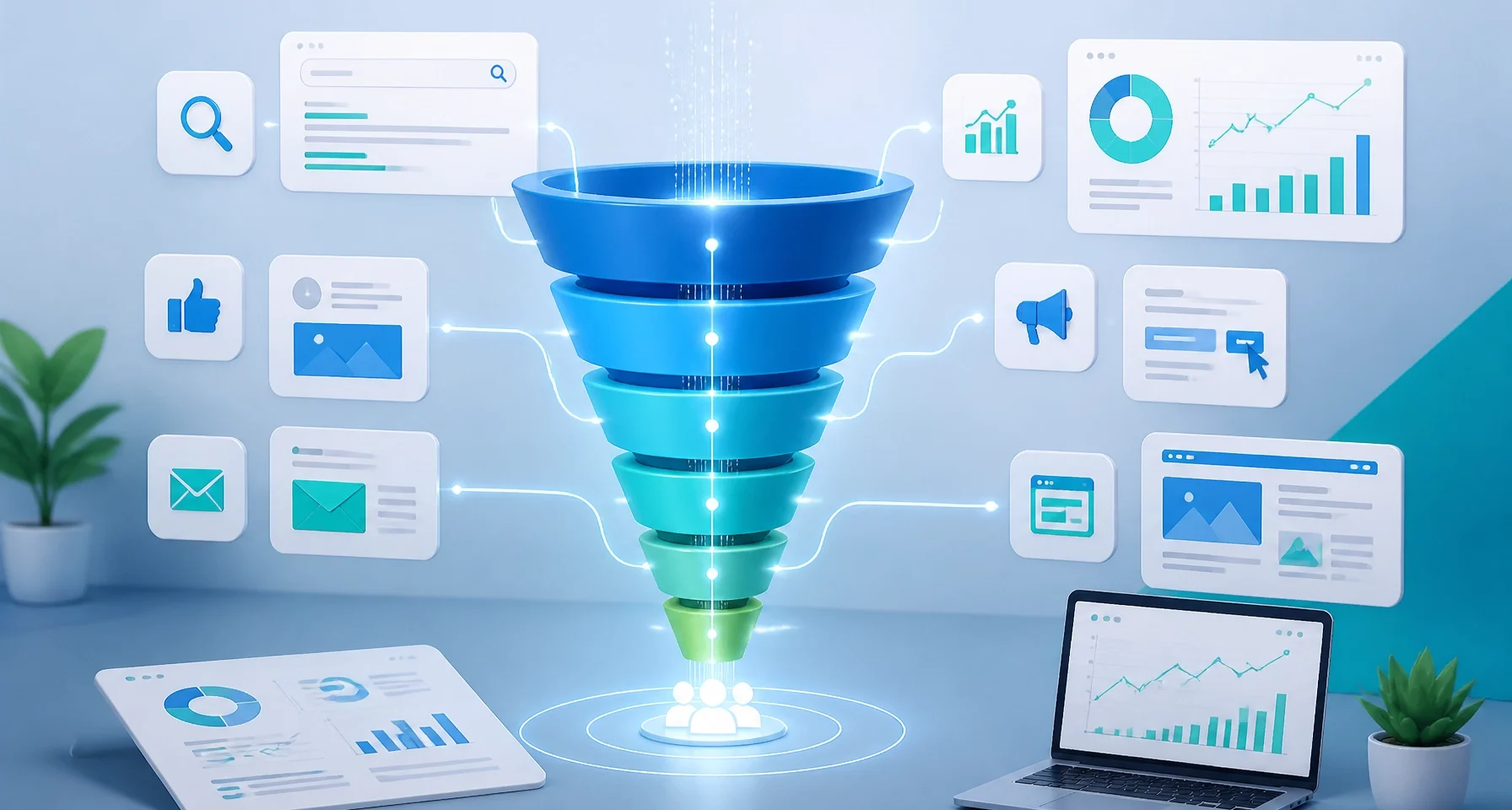
UK small businesses need more than a website, occasional social posts, or a single campaign. They need a connected digital growth system that attracts the right audience, builds trust, and turns interest into enquiries and sales.
That is where digital marketing delivers its greatest value. It brings together search engine optimisation, paid campaigns, content, email, website performance, and social media into one measurable strategy.
Within that system, search engine optimisation drives sustainable visibility. Social media marketing creates engagement and strengthens brand trust. Digital marketing connects both activities to the commercial outcomes that matter: qualified traffic, stronger conversion rates, and long-term customer relationships.
THE MODERN DIGITAL MARKETING PICTURE
Digital marketing is the complete process of promoting your business through online channels. It includes:
- Search engine optimisation and local search.
- Paid search and pay-per-click advertising.
- Social media marketing and paid social campaigns.
- Content marketing and blogging.
- Email marketing and customer nurturing.
- Website design, user experience, and conversion optimisation.
- Analytics, reporting, and campaign improvement.
These channels work best when they operate as one system. SEO can bring a prospective customer to your website. Social media can introduce your brand and provide proof that your business is trusted. Your website, landing pages, email campaigns, and customer support then move that prospect towards a decision.
The objective is not to collect likes or generate website visits without purpose. The objective is to create a reliable path from discovery to action.
For a deeper look at why disconnected campaigns underperform, read Why Your Marketing Feels Like a Chore: The Truth About Fragmented Search and How to Fix It.
WHAT SEARCH ENGINE OPTIMISATION DELIVERS
Search engine optimisation improves your website’s visibility in organic search results. It helps search engines understand your services and helps potential customers find your business when they are actively looking for a solution.
Effective SEO includes:
- Keyword and search intent research.
- Technical website optimisation.
- Service page improvements.
- Local SEO and Google Business Profile support.
- Website speed and mobile usability.
- Helpful blogs, guides, and FAQs.
- Internal linking and content structure.
- Conversion-focused page design.
- Ongoing performance monitoring.
For example, a UK customer searching for “taxi dispatch software,” “web design agency London", or “SEO services for small business” has already expressed a level of interest. A strong SEO strategy positions your business in front of that demand.
SEO is not a one-off task. Search visibility depends on technical health, content quality, authority, user experience, and consistency. Results usually build over time, but the value compounds. A well-optimised page can continue attracting relevant visitors without requiring you to pay for every click.
SEO also improves the experience after a visitor arrives. Clear navigation, useful information, fast loading times, and prominent calls to action reduce friction and support stronger conversions.
This is why professional SEO services for small businesses should focus on both visibility and commercial performance. Rankings are important, but qualified enquiries and revenue are the real measures of success.
WHAT SOCIAL MEDIA MARKETING DELIVERS
Social media marketing helps businesses reach audiences where they spend time, share interests, compare options, and discuss brands. It is a direct communication channel that allows companies to build recognition and maintain regular contact with their market.
A professional social media strategy can include:
- Content planning and publishing.
- Brand-led graphics and short-form video.
- Customer stories and testimonials.
- Educational posts and industry insights.
- Community engagement and message management.
- Paid social advertising.
- Campaign testing and audience targeting.
- Reputation and brand monitoring.
Social media performs a different role from SEO. Search captures existing demand. Social media helps create and influence demand.
A local B&B can use social content to showcase its rooms, location, and guest experience. A transport company can demonstrate its dispatch capability, reliability, and customer support. A professional services firm can share expertise through practical advice and case studies.
The strongest social content is useful, credible, and consistent. It gives people a reason to remember your business before they are ready to buy.
Social media can also support SEO indirectly. It can increase awareness of your content, encourage branded searches, generate website visits, and provide insight into the questions customers ask. Those insights can then inform new blog posts, landing pages, and FAQs.
WHERE SEO AND SOCIAL MEDIA OVERLAP
SEO and social media marketing should not operate in separate departments with separate messages. They should reinforce one another.
A single campaign can create multiple assets:
- Research a customer problem using search data and sales conversations.
- Publish a detailed, SEO-focused service page or blog post.
- Convert the main points into social media posts.
- Create a short video or graphic explaining the key benefit.
- Direct social audiences to the relevant website page.
- Use enquiries and engagement data to improve the next campaign.
This approach reduces duplication and creates a consistent customer experience. It also makes marketing more manageable for small business owners with limited time and resources.
Your keyword research can identify the topics customers care about. Social engagement can reveal the language they respond to. Website analytics can show which messages generate action. Together, these signals create a stronger and more accurate marketing strategy.
DIGITAL MARKETING TURNS ATTENTION INTO RESULTS
SEO and social media are essential, but neither channel can compensate for a weak digital foundation. Visitors need a clear, fast, and trustworthy website that makes the next step obvious.
A complete digital marketing strategy connects visibility to conversion through:
- Dedicated service pages.
- Clear value propositions.
- Mobile-first website design.
- Simple contact and booking forms.
- Strong calls to action.
- Customer testimonials and case studies.
- Secure hosting and minimal downtime.
- Analytics and conversion tracking.
- Email follow-up and customer support.
This is where the wider role of a digital marketing agency in the UK becomes valuable. Instead of managing isolated activities, an integrated partner can align your website, SEO, social media, paid campaigns, content, and reporting.
Our guide, Search Engine Marketing in 2026: How SEO, Google Ads, and Email Work Together for UK Small Businesses, explains how paid search and email can extend the impact of organic visibility.
The commercial journey should be straightforward:
Visibility attracts attention. Engagement builds trust. Website experience supports confidence. Conversion-focused marketing creates action. Follow-up turns customers into repeat business.
BUILDING A UNIFIED STRATEGY FOR YOUR BUSINESS
A successful integrated strategy begins with your business objectives, not with a list of platforms.
1. DEFINE THE COMMERCIAL GOAL
Choose a clear target for the next 90 days. This might include:
- Increasing qualified enquiries.
- Generating more local bookings.
- Improving online sales.
- Reducing customer acquisition costs.
- Increasing repeat purchases.
- Building awareness in a new UK region.
Every channel should support this objective.
2. IDENTIFY YOUR BEST CUSTOMERS
Understand who you serve, what they need, and what prevents them from taking action. Review common questions, sales objections, customer messages, and competitor gaps.
This information creates better keywords, more relevant social content, and stronger website messaging.
3. STRENGTHEN YOUR DIGITAL FOUNDATIONS
Before scaling traffic, make sure your website is ready. Review:
- Page speed.
- Mobile responsiveness.
- Navigation.
- Contact forms.
- Service descriptions.
- Tracking and analytics.
- Calls to action.
- Security and hosting reliability.
Sending more visitors to a confusing website increases waste. Fix the conversion journey first.
4. PRIORITISE HIGH-VALUE CHANNELS
Small businesses do not need to be everywhere. They need to be effective where their customers are most active.
A local service business may prioritise local SEO, Google Business Profile optimisation, and Facebook or Instagram. A B2B consultancy may focus on SEO, LinkedIn, email, and expert-led content. An e-commerce business may combine SEO, product content, social advertising, and email automation.
Select the channels that match customer behaviour and available resources.
5. CREATE A CONTENT SYSTEM
Build three or four content pillars around your expertise. Typical pillars include:
- Customer education.
- Product or service benefits.
- Proof of results.
- Company values and team expertise.
Use one central topic across multiple formats. A detailed blog can become a LinkedIn post, a social carousel, an email, and a short video. This delivers consistent messaging while reducing production time.
6. MEASURE BUSINESS IMPACT
Track metrics that support decisions:
- Organic traffic.
- Search impressions and clicks.
- Qualified leads.
- Conversion rate.
- Cost per lead.
- Social engagement quality.
- Website-generated revenue.
- Repeat customer rate.
Followers and impressions may indicate reach, but they do not prove commercial success on their own.
A PRACTICAL 30-DAY ACTION PLAN
Use this framework to begin building an integrated strategy.
WEEK 1: AUDIT AND PRIORITISE
Review your website, search visibility, social profiles, competitors, customer journey, and existing analytics. Identify the three biggest barriers to growth.
WEEK 2: IMPROVE YOUR FOUNDATIONS
Optimise your key service pages, improve calls to action, check mobile performance, update business information, and ensure enquiries are tracked correctly.
WEEK 3: LAUNCH CONNECTED CONTENT
Publish one useful SEO-focused article or service page. Repurpose it into several social posts. Use the same core message across your website and social profiles.
WEEK 4: REVIEW AND REFINE
Measure traffic, engagement, enquiries, and conversions. Identify which topics and messages performed best. Use that insight to plan the following month.
This process creates momentum without spreading your budget and attention too thinly.
WHY INTEGRATION CREATES STRONGER GROWTH
The digital landscape continues to evolve. Customers use search engines, social platforms, maps, review sites, and AI-powered tools to research businesses. A modern strategy must therefore make your brand clear and discoverable across multiple customer touchpoints.
Our SEO vs GEO guide explores how businesses can respond to changing search and discovery behaviour. The central lesson is simple: visibility alone is not enough. Your business must provide useful information, consistent branding, credible proof, and a low-friction route to conversion.
Global Marketing Firm provides end-to-end technology and marketing solutions for UK businesses. Our capabilities include SEO, social media marketing, PPC, email campaigns, web design, app development, UI/UX design, customer support, hosting, cloud services, and disaster recovery.
We deliver with a 100% on-time delivery record and an 85% repeat business rate. Our team listens, understands, and delivers solutions built for measurable growth. We also provide 24/7 customer support and communication solutions, including specialist taxi dispatch support for the transportation sector.
Our approach is professional, scalable, ethically driven, and focused on long-term value.
TURNING DIGITAL VISIBILITY INTO BUSINESS GROWTH
Digital marketing, SEO, and social media marketing are not competing priorities. They are connected parts of one growth engine.
SEO helps customers find you. Social media helps them notice and trust you. Your wider digital marketing strategy turns that attention into enquiries, sales, and repeat business.
The businesses that perform best are not necessarily the ones publishing the most content or spending the most money. They are the businesses with a clear message, reliable digital foundations, consistent execution, and accurate measurement.
Ready to build a unified strategy for your business? Book a consultation with Global Marketing Firm and turn clicks, conversations, and customer interest into measurable commercial results.