


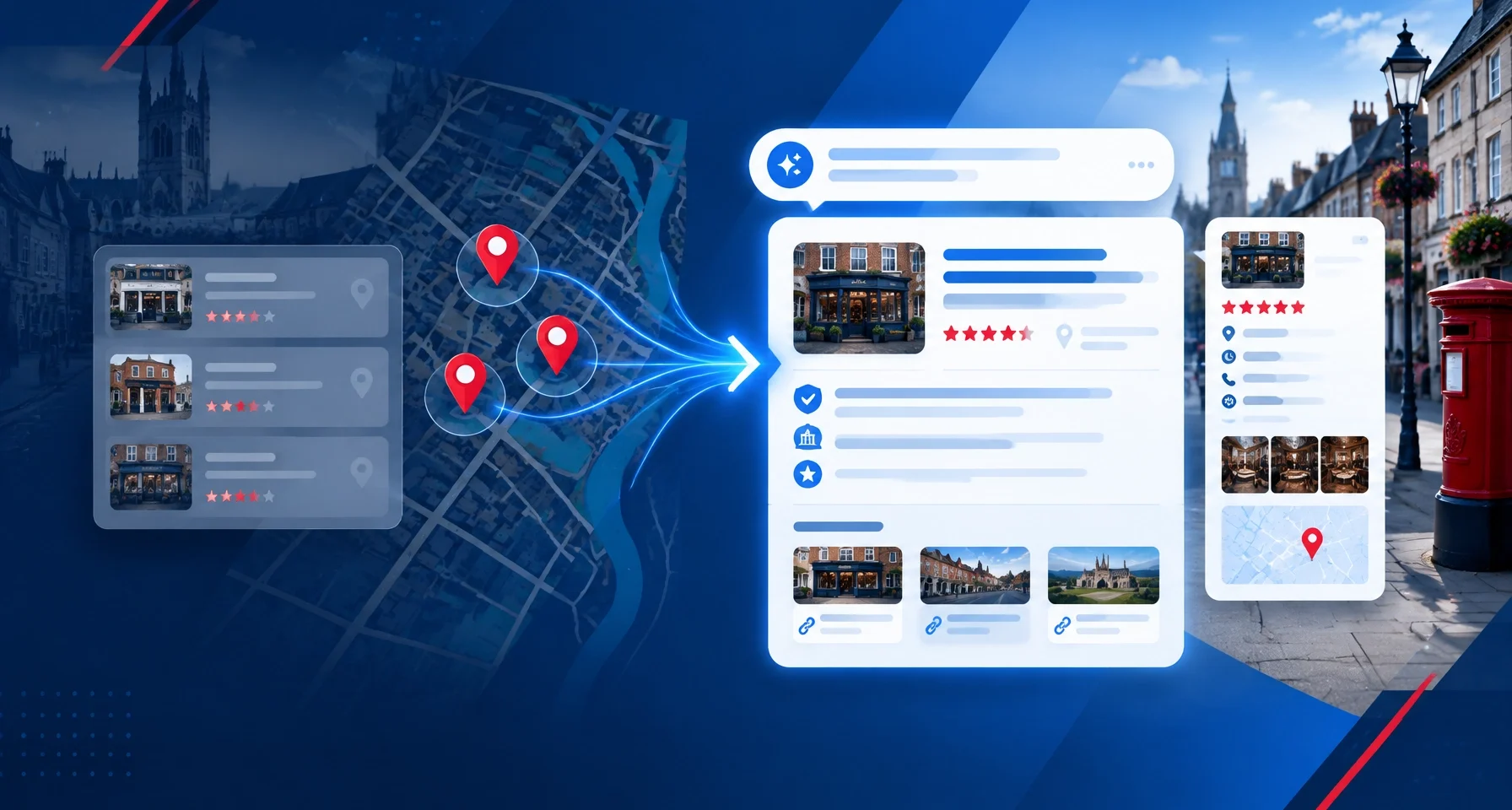
The Map Pack Is Shrinking: How UK Local Businesses Win When AI Answers Replace the Local Listings
The familiar Google local search journey is changing.
A customer searches for “best Italian restaurant near me”, “emergency plumber in Manchester” or “taxi service near Heathrow”. Previously, the three-pack of local listings was the central battleground. Businesses competed for one of three visible positions, supported by their Google Business Profile, reviews, proximity and website relevance.
Now, the customer may see an AI Overview first. Google AI Mode may continue the conversation. Gemini-powered local results may combine business information, reviews, opening hours, services and web content into one answer.
The result is simple: fewer businesses receive prominent visibility for the same local query.
This is not a reason to panic. It is a reason to update the local search strategy before Q4 demand accelerates.
THE LOCAL PACK IS NOT DISAPPEARING, BUT IT IS LOSING SPACE
The classic local pack still matters. Customers continue to use Google Maps, call businesses directly, request directions and compare reviews.
However, it no longer owns the entire local search experience.
AI Overviews can summarise local options before the traditional listings appear. AI Mode can answer follow-up questions such as:
- “Which one is open after 8pm?”
- “Which has the best reviews for families?”
- “Which plumber serves South London and offers same-day appointments?”
- “Which taxi company can handle an airport transfer for six passengers?”
Google is also testing richer local interfaces, aggregator-style units and conversational experiences connected to Maps data. In many searches, the user receives a shortlist rather than browsing every available listing.
Industry tracking in 2026 has reported AI Overviews appearing across a significant share of local searches, in some datasets more frequently than traditional local packs. That changes the competitive model. You are no longer competing only to be one of three businesses on a map.
You are competing to become one of the few businesses that an AI system considers relevant, reliable and easy to recommend.
WHY AI ANSWERS ARE REPLACING CLASSIC LOCAL LISTINGS
The shift is being driven by three connected changes.
AI OVERVIEWS ARE BECOMING THE FIRST LOCAL ANSWER
AI Overviews combine information from multiple sources and present a direct response above or alongside traditional results. For local searches, that answer may include:
- Business names and categories.
- Review themes and ratings.
- Services and attributes.
- Opening hours and location information.
- Website content and local guides.
- Links to sources for further research.
Recent changes have also seen AI Overviews linking out to sources again. That creates an opportunity for businesses with clear, useful and authoritative pages. The click may not come from a blue link or a map listing. It may come from a cited source inside an AI-generated answer.
AI MODE TURNS LOCAL SEARCH INTO A CONVERSATION
AI Mode allows users to refine a local request without starting a new search each time. A customer can move from “best gym near me” to “which has beginner classes, free parking and early morning opening?”
This places more importance on complete business information. A profile that only states “gym” provides limited machine-readable context. A profile that clearly explains classes, facilities, opening hours, parking, accessibility and service areas gives AI systems more useful information to work with.
This is also where conversational optimisation matters. Our guide, “Hey Google, Which Plumbers Are Open?”, explains why natural-language questions and urgent local intent now deserve specific attention.
GEMINI CONNECTS LOCAL DATA INTO ONE ENTITY VIEW
Gemini-powered local results do not treat your website, Google Business Profile, reviews, directories and mentions as isolated assets. They help form a wider picture of your business entity.
If your name, address, phone number, services and opening hours conflict across platforms, the system has to resolve that uncertainty. If your website says one thing, your GBP says another and a directory lists an old phone number, your entity becomes harder to trust.
The objective is consistency, clarity and evidence.
THE SEPTEMBER 2026 SPAM UPDATE MAKES QUALITY NON-NEGOTIABLE
The September 2026 spam update began rolling out globally on 24 September, with a rollout window extending into early October. Ranking volatility has been visible across organic and local results.
That volatility does not mean every business has been penalised. It means Google is reassessing pages, profiles and sites that may contain low-value, manipulative or misleading signals.
Local businesses should pay particular attention to:
- Thin location pages with near-identical wording.
- Keyword-stuffed business descriptions.
- Doorway pages created for every nearby town.
- AI-generated content with little first-hand value.
- Purchased or incentivised reviews.
- Inconsistent business information.
- Suspicious review spikes or coordinated negative activity.
Google has also increased attention on fake reviews. Gemini-powered systems are being used to identify unusual review patterns, which makes artificial reputation-building a serious business risk.
The calm response is an audit, not a panic-led rebuild. Review performance before and after the update, identify genuine weaknesses and correct the areas that reduce trust.
For broader context on the changing search environment, read “The Future of Google Search: What UK Marketers Need to Know”.
THE PRACTICAL PLAYBOOK FOR WINNING AI-LED LOCAL SEARCH
1. TREAT GBP AS A LIVE DATA FEED
Your Google Business Profile is no longer a static online listing. It is an active source of business information used across Search, Maps and AI-powered local experiences.
Review every field:
- Business name and primary category.
- Secondary categories.
- Services and products.
- Opening hours and holiday hours.
- Service areas.
- Attributes and accessibility information.
- Booking, contact and appointment links.
- Current photographs.
- Frequently asked questions.
- Posts, updates and seasonal offers.
Do not add keywords where they do not belong. Use precise, customer-focused language that makes the business easy to understand.
2. BUILD REVIEW VELOCITY, NOT REVIEW VOLUME ALONE
A high review count is useful. A steady flow of authentic, recent and detailed reviews is more valuable.
Create a simple process that asks genuine customers for feedback after a completed purchase, booking or service. Make the request easy to complete on mobile. Respond to every review professionally, including negative feedback.
Never buy reviews or pressure customers to provide a specific rating. Gemini and other automated systems are becoming better at detecting unnatural patterns.
Review relevance also matters. A detailed review that mentions your service, location and customer experience provides more context than a generic “great company”.
3. FIX NAP CONSISTENCY ACROSS THE WEB
NAP means name, address and phone number. These core details must match across:
- Your website.
- Google Business Profile.
- Business directories.
- Industry platforms.
- Social profiles.
- Local publications.
- Review websites.
Check formatting as well as accuracy. Variations such as different phone numbers, old addresses or inconsistent trading names can weaken entity confidence.
Consistency also applies to services. If your GBP lists airport transfers but your website only describes general taxi bookings, clarify the relationship between the two.
4. IMPLEMENT LOCAL BUSINESS SCHEMA CORRECTLY
The LocalBusiness schema gives search systems structured information about your business. Depending on your organisation, relevant properties may include:
- Business name.
- Address.
- Telephone number.
- Opening hours.
- Service area.
- Price range.
- Geo-coordinates.
- Website and logo.
- Reviews where appropriate.
Schema is not a shortcut to an AI citation. It is a clarity layer. It helps machines interpret information that should already be visible and accurate on the page.
5. STRENGTHEN ENTITY SIGNALS
AI systems need to establish that different references relate to the same real-world business.
Build that connection through:
- A consistent brand name.
- A clear About page.
- Local staff, premises or service-area details.
- Authoritative industry mentions.
- Local partnerships and community involvement.
- Case studies and customer evidence.
- Active social profiles.
- Clear service and location pages.
Our Generative Engine Optimisation guide explains how businesses can move from traditional rankings towards visibility in AI-generated answers.
6. MAKE YOUR CONTENT QUOTABLE
AI systems need extractable information. They favour pages that answer specific questions clearly rather than burying the answer beneath generic marketing language.
Create content with:
- Direct answers near the top.
- Short, descriptive headings.
- Clear service explanations.
- Local proof and examples.
- Transparent pricing guidance where appropriate.
- FAQs based on real customer questions.
- Useful comparisons.
- Accurate dates, locations and opening hours.
This is not about writing for robots. It is about making your expertise easy for customers and search systems to understand.
Our AI Discovery File framework provides a practical way to organise these signals across your website, GBP, reviews and external mentions.
Q4 IS THE DEADLINE, NOT THE STARTING POINT.
The Q4 local search season is about to begin. For many UK businesses, seasonal demand starts building in October and peaks in November and December.
That leaves limited time to improve visibility before customers begin searching for:
- Christmas services and events.
- Festive menus and party venues.
- Gift experiences.
- Emergency trades and repairs.
- Travel and airport transfers.
- Holiday opening hours.
- Last-minute local availability.
Use our Q4 local search plan to prioritise seasonal pages, GBP updates, review activity and local content before peak demand arrives.
BUILD VISIBILITY BEYOND THE MAP PACK
The businesses that win this transition will not abandon local SEO. They will expand it.
They will use SEO Services UK to protect organic visibility, SEO Services for Small Business to build cost-effective foundations and Local SEO Services UK to strengthen GBP, reviews and local relevance. They will also coordinate these activities through a capable Digital Marketing Agency UK that understands how SEO, content, paid search, social media, web development and analytics work together.
At Global Marketing Firm, we combine these disciplines with a proven delivery record: more than 1,000 projects completed, a 100% on-time delivery record and an 85% repeat business rate.
The map pack is becoming smaller. Your opportunity is to become more useful, more trusted and more quotable across every local search surface.
That is how UK local businesses continue turning searches into calls, bookings and customers when AI answers take centre stage.